Wandering Through Concrete Dreams: Addis Ababa’s Hidden Architectural Soul
Ever wondered what happens when African pride meets bold modern design? I wandered Addis Ababa with no plan—just my eyes wide open—and stumbled upon a city where concrete dances, colors shout history, and every building tells a story. From Soviet-era blocks to dazzling Orthodox cathedrals, the architecture here isn’t just structure; it’s identity in motion. This is urban poetry you can walk through. More than a capital, Addis Ababa is a living dialogue between tradition and transformation, where every street corner offers a glimpse into Ethiopia’s soul. To truly know this city, one must look beyond the surface and see the walls as witnesses, the rooftops as storytellers, and the spaces in between as chapters of a nation still writing itself.
First Impressions: Stepping into a City of Contrasts
Arriving in Addis Ababa is like stepping into a city that refuses to be defined by a single era. The first view from Entoto Hill reveals a sprawling metropolis nestled in a highland basin, its rooftops a patchwork of red tile, corrugated metal, and poured concrete. Unlike many African capitals shaped by colonial grids, Addis grew organically—up hillsides, around market clusters, and along winding roads that follow the land’s natural contours. There is no rigid order, yet there is rhythm. The city breathes with irregularity, each neighborhood unfolding like a personal narrative shaped by time, need, and resilience.
The skyline tells a layered story. Towering glass facades of modern office complexes stand beside low-rise neighborhoods where hand-painted signs mark local businesses and open-air markets spill into the streets. In the Piazza district, European-style balconies with wrought iron railings contrast with the vibrant street life below, where women in traditional white cotton dresses carry bundles on their heads and men in leather sandals sip coffee from small ceramic cups. This is not a city of stark divides, but one of constant conversation—between past and present, between global influence and local identity.
What strikes most is how the city’s topography shapes its architecture. Buildings climb steep slopes, terraced like agricultural fields, their foundations anchored into the red earth. Staircases zigzag between homes, and narrow alleys become vital connectors in a vertical urban fabric. There are no grand boulevards carved for imperial processions, no forced symmetry. Instead, Addis Ababa reveals a kind of democratic disorder—a city built by its people, for its people, where form follows function and survival often precedes aesthetics. This organic growth, unplanned yet deeply intuitive, gives the city a human scale that feels both chaotic and deeply authentic.
The absence of colonial grid planning, a rare trait among African capitals, speaks to Ethiopia’s unique history as a nation that remained independent during the Scramble for Africa. While Italian occupation in the 1930s left architectural traces, they were absorbed rather than imposed. The city’s layout reflects a cultural resistance to external control, a physical manifestation of self-determination. Even today, new developments often follow the flow of existing communities rather than erasing them. This respect for organic growth makes Addis Ababa not just a place to visit, but a place to study—a model of urban evolution shaped by local logic rather than foreign blueprints.
The Legacy of Modernism: Ethiopia’s Mid-Century Vision
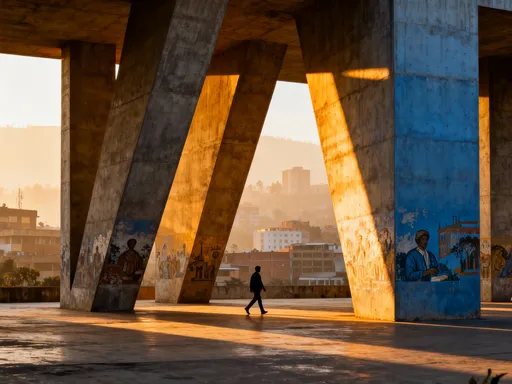
Between the 1960s and 1970s, Addis Ababa entered an era of ambitious nation-building, and its architecture became a canvas for modernist ideals. Under Emperor Haile Selassie, Ethiopia sought to project itself as a forward-looking African leader, and the capital was transformed with sweeping government projects. This was the golden age of Ethiopian modernism—a time when concrete was not just a material, but a symbol of progress. Buildings rose with clean lines, flat roofs, and open plazas, drawing inspiration from the International Style and Brutalism while adapting to local climate and culture.
The Africa Hall, headquarters of the United Nations Economic Commission for Africa, stands as one of the most iconic examples. Completed in 1961, its symmetrical façade and elevated podium reflect mid-century diplomatic architecture, yet its interior incorporates Ethiopian motifs—handwoven textiles, carved wood panels, and ceiling designs echoing traditional patterns. The building was not merely functional; it was a political statement, declaring Africa’s presence on the global stage. Similarly, the Addis Ababa University campus features wide walkways, modular classrooms, and shaded courtyards that blend modernist efficiency with passive cooling techniques suited to the highland climate.
Foreign architects, including Brazilian and German designers, played a role in shaping this era, but local engineers and builders reinterpreted their plans with available materials and practical needs. Reinforced concrete became the dominant medium, not only for its durability but also for its flexibility in form. Yet, unlike the cold austerity often associated with Brutalism, Addis Ababa’s modernist buildings were softened by human touch—colorful paint, handmade railings, and rooftop gardens that turned sterile structures into lived spaces. The Parliament Building, with its geometric symmetry and grand colonnade, exemplifies this blend of authority and accessibility.
What makes this period significant is not just its architectural output, but its underlying philosophy. Modernism in Addis Ababa was never about mimicking the West. It was about claiming modernity on African terms. These buildings were not imported ideals; they were tools for nation-building, designed to house ministries, universities, and cultural institutions that would shape Ethiopia’s future. Even today, walking through these structures evokes a sense of purpose—a reminder that architecture can be both functional and aspirational, a bridge between tradition and ambition.
Religious Architecture: Where Faith Meets Form
In a city defined by political and social change, religious architecture remains a constant—a spiritual anchor amidst urban flux. The Ethiopian Orthodox Church, with its deep roots in the nation’s identity, has shaped the skyline with structures that are both sacred and symbolic. Among them, St. George Cathedral stands as a powerful example of how faith and form intertwine. Built in 1896 to commemorate Ethiopia’s victory over Italian forces at the Battle of Adwa, the cathedral’s unique octagonal design reflects both architectural innovation and theological meaning.
The circular layout of the cathedral is not merely aesthetic; it represents eternity, a concept central to Orthodox theology. Each side of the octagon corresponds to a stage in the life of Christ, guiding worshippers through a physical journey that mirrors spiritual progression. Inside, the walls are covered in vivid murals depicting biblical scenes in a distinctly Ethiopian style—figures with almond-shaped eyes, richly colored robes, and gold-leaf halos. These paintings are not just decoration; they are visual sermons, teaching scripture to a largely illiterate congregation. The dim lighting, the scent of frankincense, and the rhythmic chanting create an atmosphere where time seems to pause, and the divine feels near.
St. George is not alone. Across the city, Orthodox churches rise with distinctive cupolas and bell towers, their exteriors often painted in bold reds, greens, and whites—the colors of the Ethiopian flag. While urban churches like Holy Trinity Cathedral feature grand scale and imported materials, rural counterparts such as those in Lalibela are carved directly from rock, a testament to centuries-old craftsmanship. Yet even in the capital, the influence of rock-hewn architecture can be seen in the way modern churches incorporate stone cladding and cave-like interiors, creating a sense of continuity between past and present.
What sets Ethiopian religious architecture apart is its integration into daily life. Churches are not isolated sanctuaries; they are community centers, gathering places, and cultural guardians. On Sundays, the courtyards fill with families in their finest clothes, children playing near fountains, elders sharing stories under shaded arcades. The architecture facilitates connection—not just between people and God, but among people themselves. In a rapidly modernizing city, these spaces offer stability, a reminder that some values transcend time and trend.
The Soviet Echo: Housing Blocks and Urban Planning
Following the fall of Emperor Haile Selassie in 1974, the Marxist Derg regime ushered in a new era of urban development—one defined by socialist ideals and centralized planning. The most visible legacy of this period is the network of multi-story apartment blocks that still house a significant portion of Addis Ababa’s population. Built primarily in the 1980s, these structures were designed to provide affordable, efficient housing for the working class. Constructed with prefabricated concrete panels, they reflect the functional minimalism of Soviet urban design, prioritizing utility over ornamentation.
Today, these buildings are weathered but enduring. Many show signs of decades of use—cracked facades, rusting railings, and patched roofs—but they remain vital. What was once a symbol of state control has become a testament to resilience. Residents have reclaimed these spaces, painting doors in bright colors, hanging laundry like banners, and converting ground floors into small shops and cafes. In neighborhoods like Kazanchis and Bole, the housing blocks are not cold relics, but living communities where generations have grown up together.
The layout of these complexes often follows a modular pattern—repeating units arranged around central courtyards, with shared water points and stairwells. While lacking in privacy by modern standards, they foster a sense of collective life. Neighbors know each other by name, children play in common areas, and elders sit on benches exchanging news. This communal living, though born of ideology, has evolved into a social fabric that many residents value deeply. The architecture, though austere, has become a vessel for human connection.
Yet challenges remain. Many of these buildings suffer from poor maintenance, inadequate sanitation, and overcrowding. As the city expands, there is increasing pressure to demolish and redevelop. But such efforts risk displacing long-standing communities. The debate over these housing blocks is not just about urban renewal; it is about memory, identity, and the right to the city. Preserving them does not mean freezing them in time, but recognizing their role in Addis Ababa’s social history. They are not monuments to a failed regime, but homes to thousands who have made them their own.
Contemporary Twists: New Money, New Materials
In the past two decades, Addis Ababa has experienced a construction boom unlike any in its history. Driven by economic growth, foreign investment, and a rising middle class, the city is reshaping its skyline with glass towers, shopping malls, and luxury condominiums. The Bole district, once a quiet suburb, now pulses with high-rise developments, many built with Chinese financing and engineering. These new structures boast energy-efficient glazing, elevators, and modern amenities, signaling a shift toward global urban standards.
The Friendship Square complex, a mixed-use development featuring retail, office, and residential spaces, exemplifies this trend. With its sleek façade and landscaped plazas, it could belong in Dubai or Shanghai. Similarly, the Ethiopian International Bank Tower stands as a vertical statement of economic ambition, its reflective surface catching the highland sunlight. These buildings cater to a new generation of professionals, entrepreneurs, and returning diaspora members seeking modern comforts and cosmopolitan lifestyles.
Yet this transformation is not without controversy. Critics argue that the rapid pace of development threatens the city’s architectural character. Historic neighborhoods are being cleared for high-rises, and street-level vibrancy is giving way to gated enclaves. There is concern that Addis Ababa is losing its soul in pursuit of modernity. The use of imported materials and foreign design templates often overlooks local climate needs—glass towers that overheat in the sun, wide roads that prioritize cars over pedestrians.
Moreover, the benefits of this growth are unevenly distributed. While a few enjoy penthouse views, many still live in informal settlements with limited access to water and electricity. The contrast between old and new is no longer just aesthetic; it is deeply social. The challenge now is to ensure that development serves all citizens, not just the elite. This means integrating sustainable design, preserving cultural landmarks, and involving communities in planning decisions. Addis Ababa does not need to choose between progress and heritage—it can honor both, if it builds with intention and inclusion.
Hidden Gems: Off-the-Beaten-Path Structures
Beyond the well-known landmarks, Addis Ababa hides architectural treasures that reveal the city’s quieter, more personal side. These are not monuments to power or faith, but spaces shaped by everyday life and creative expression. One such gem is the old Rex Cinema in Piazza, a retro theater from the 1930s with an arched entrance and Art Deco detailing. Though no longer in use, its façade remains a nostalgic reminder of a time when cinema was a communal ritual. The surrounding streets still buzz with small theaters showing Amharic films, their hand-painted posters flapping in the wind.
Another hidden wonder is the Mercato district, one of Africa’s largest open-air markets. Here, vaulted metal roofs stretch over labyrinthine alleys, creating a cathedral-like canopy under which thousands buy and sell goods daily. The architecture is utilitarian, yet poetic—corrugated sheets curved into arches, wooden beams supporting decades of trade. Walking through Mercato is not just a shopping experience; it is an immersion in the city’s economic heartbeat, where every stall, every doorway, every patch of shade tells a story of survival and enterprise.
In the quieter neighborhood of La Gare, clusters of 1930s Italian-influenced villas still stand, their pastel walls, tiled roofs, and shuttered windows evoking a bygone era. Some have been converted into cafes, guesthouses, or design studios, preserving their charm while adapting to modern use. These homes, with their inner courtyards and climbing bougainvillea, offer a glimpse into a more intimate Addis Ababa—one of shaded verandas, afternoon coffee, and slow conversation.
Discovering these places requires no map, only curiosity. They are best found by wandering without agenda, letting the city guide your steps. In doing so, one learns that architecture is not only about grand statements, but about the textures of daily life—the chipped paint on a doorframe, the way sunlight filters through a metal roof, the laughter echoing in a courtyard. These moments, fleeting yet profound, are what make Addis Ababa not just a city to see, but a city to feel.
Architecture as Identity: Why It Matters Beyond Beauty
Addis Ababa’s buildings are more than shelters; they are expressions of a nation’s journey. Each structure—whether a Soviet-era block, a modernist university, or a centuries-old church—carries the weight of history, ideology, and aspiration. Together, they form a living archive, one that tells the story of a country that has resisted colonization, navigated political upheaval, and continued to evolve on its own terms. The city’s architectural diversity is not accidental; it is a reflection of Ethiopia’s complex identity—proud, resilient, and constantly redefining itself.
To walk through Addis Ababa is to witness the interplay between global influences and local agency. Foreign styles have arrived—from Italian colonialism to Chinese investment—but they have been absorbed, adapted, and transformed. The city does not mimic; it negotiates. It takes what serves it and reshapes it in its own image. This is not cultural erasure, but cultural resilience. The concrete blocks of the Derg era, once symbols of control, have become homes. The modernist government buildings, once statements of power, now house the everyday work of democracy. Even the new glass towers, though global in appearance, are filled with Ethiopian dreams.
For travelers, this means seeing the city not as a static destination, but as a dynamic process. Architecture becomes a lens through which to understand values, struggles, and hopes. It invites deeper engagement—not just sightseeing, but listening to the stories walls can tell. When we appreciate a building not just for its beauty, but for its meaning, we begin to see cities as living entities, shaped by people as much as by planners.
As Addis Ababa continues to grow, the challenge will be to build with memory as well as vision. Development should not erase the past, but build upon it. Historic neighborhoods deserve protection, not demolition. Public spaces should be designed for people, not just profit. And above all, architecture should remain a collective expression, not a privilege for the few. The soul of a city is not in its tallest tower, but in its ability to hold all its people—past, present, and future—within its embrace.
In the end, Addis Ababa teaches us that buildings are never just concrete and steel. They are vessels of identity, monuments to survival, and promises of what is yet to come. To wander through its streets is to walk through a dream still being built—one brick, one story, one life at a time.